Vincent Van Gogh as a Child Vincent Van Gogh as a Baby
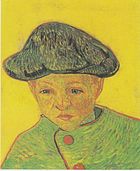
| Portrait of Camille Roulin | |
|---|---|
 | |
| Artist | Vincent van Gogh |
| Yr | 1888 |
| Medium | Oil on canvas |
| Dimensions | 40.v cm × 32.5 cm (15.9 in × 12.8 in) |
| Location | Van Gogh Museum, Amsterdam |
Vincent van Gogh enjoyed making Paintings of Children. He once said that it's the but thing that "excites me to the depths of my soul, and which makes me feel the infinite more than anything else." Painting children, in particular represented rebirth and the space. Over his career Van Gogh did not make many paintings of children, but those he completed were special to him. During the ten years of Van Gogh's career as a painter, from 1881 to 1890, his work changed and grew richer, particularly in how he used color and techniques symbolically or evocatively.
His early works were earth-toned and ho-hum. After a transformative period in Paris, Van Gogh embarked on his near prolific periods starting in Arles, in the south of French republic and continuing until his final days in Auvers-sur-Oise. During those times his piece of work became more than colorful and more than cogitating of influences, such as Impressionism and Japonism. Japonism influences are understood in the painting of a young girl, La Mousmé. Amid others, he was inspired past the work of Jean-François Millet which he emulated in Starting time Steps and Evening: The Watch.
Van Gogh enjoyed painting portraits when he had available models. Maybe the greatest affect to his paintings of children came out of the friendship with Joseph Roulin and the many paintings of his family unit.
Portraits [edit]
Van Gogh, known for his landscapes, seemed to find painting portraits his greatest ambition.[ane] He said of portrait studies, "the only thing in painting that excites me to the depths of my soul, and which makes me experience the space more than than anything else."[2]
To his sister he wrote, "I should like to paint portraits which appear afterward a century to people living and so as apparitions. By which I mean that I do not endeavor to reach this through photographic resemblance, merely my ways of our impassioned emotions -- that is to say using our cognition and our modern taste for color as a means of arriving at the expression and the intensification of the character."[1]
Convey comfort [edit]
Of painting portraits, Van Gogh wrote: "in a picture I desire to say something comforting as music is comforting. I desire to pigment men and women with that something of the eternal which the halo used to symbolize, and which we seek to communicate by the actual radiance and vibration of our coloring."[3]
Infants [edit]
Van Gogh saw "something deeper, more intimate, more than eternal than the body of water in the expression of the eyes of a trivial baby when information technology wakes in the morning." Infants which represented "rebirth and immortality" to Van Gogh and lightened his mood. When he had the opportunity, Van Gogh enjoyed painting them.[4]
Peasant genre [edit]
The "peasant genre" that profoundly influenced Van Gogh began in the 1840s with the works of Jean-François Millet, Jules Breton, and others. In 1885 Van Gogh described the painting of peasants as the most essential contribution to modern fine art. He described the works of Millet and Breton of religious significance, "something on high."[5] Referring to painting of peasants Van Gogh wrote to his brother Theo: "How shall I ever manage to pigment what I honey and then much?"[vi]
This was a decided transition in approach to paintings from his earlier works influenced by Dutch masters, such as Rembrandt. His goal at that time was to paint them every bit he saw them and based upon his emotional response to them. His early works of peasants were in muted tones. As he was influenced past Impressionism and the use of complementary colors, his manner changed dramatically.[seven]
Models [edit]
As much as Van Gogh liked to paint portraits of people, there were few opportunities for him to pay or conform for models for his work. He found a bounty in the work of the Roulin family, for which he made several images of each person. In exchange, Van Gogh gave the Roulin'southward ane painting for each family unit fellow member.[8]
Netherlands [edit]
Boy Cutting Grass with a Sickle, made in 1881, is owned by the Kröller-Müller Museum.[9]
Of a report that Van Gogh made for Girl in a Wood or Girl in White in the Woods, [10] he remarked at how much he enjoyed the work and explains how he wishes to trigger the audience's senses and how they may experience the painting: "The other report in the wood is of some large green beech trunks on a stretch of ground covered with dry sticks, and the little figure of a daughter in white. There was the smashing difficulty of keeping it clear, and of getting space between the trunks standing at different distances - and the place and relative bulk of those trunks change with the perspective - to arrive and then that one can exhale and walk around in it, and to brand you smell the fragrance of the wood."[11]
In The Girl in the Woods the girl is overshadowed by the immense oak trees. The painting may be reminiscent for Van Gogh of the times in his youth he fled to the Zundert Woods to escape from his family.[12]
| | | Girl in the Woods, 1882, Private Drove (F8a) |


A Girl in the Street, Two Coaches in the Groundwork and Peasant Adult female with Child on Her Lap are both part of private collections.[thirteen]
Van Gogh was attracted to Sien partly for her pregnancy and fabricated use of the opportunity to paint her babe boy.[four]
Van Gogh reached a signal around 1885 when he was looking to free himself physically, emotionally and artistically from the gray colors of his art and life, moving away from Nuenen to develop, as author Albert Lubin describes, a more "imaginative, colorful art that suited him much better."[14]
Parisian influences [edit]
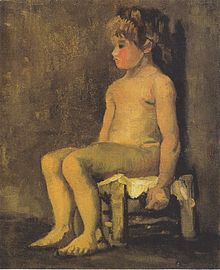
In 1886, Van Gogh left holland never to return. He moved to Paris to alive with his brother Theo, a Parisian art dealer. Van Gogh entered Paris as a shy, somber human being. While his personality would never modify, he emerged artistically into what one critic described as a "singing bird".[15] Although Van Gogh had been influenced by his cousin Anton Mauve and the Hague School, as well as the great Dutch masters, coming to Paris meant that he was exposed to Impressionism, Symbolists, Pointillists, and Japanese art (meet Japonism). His circle of friends included Camille Pissarro, Henri de Toulouse-Lautrec, Paul Gauguin, Émile Bernard, Paul Signac, and others. The works of the Japanese printmakers Hiroshige and Hokusai greatly influenced Van Gogh, both for the discipline thing and the way of flat patterns of colors without shadow. In the 2 years from 1886 through 1888 he spent working in Paris, Van Gogh explored the various genres, creating his own unique manner.[xv]
Arles [edit]
Van Gogh moved to Arles in southern France where he produced some of his best piece of work. His paintings represented different aspects of ordinary life, such as portraits of members of the Roulin family and La Mousmé. The sunflower paintings, some of the virtually recognizable of Van Gogh's paintings, were created in this time. He worked continuously to keep up with his ideas for paintings. This is likely i of Van Gogh's happier periods of life. He is confident, clear-minded and seemingly content.[16]
In a letter to his brother, Theo, he wrote, "Painting as it is at present, promises to become more than subtle - more like music and less like sculpture - and above all, it promises color." As a means of caption, Vincent explains that existence like music means being comforting.[16]
Van Gogh painted the family of postman Joseph Roulin in the winter of 1888, every member more than than once.[17] The family included Joseph Roulin, the postman, his wife Augustine and their iii children. Van Gogh described the family as "really French, even if they look like Russians."[eighteen] Over the course of simply a few weeks, he painted the Augustine and the children several times. The reason for multiple works was partly then that the Roulin's could have a painting of each family fellow member, and so that with these pictures and others, their sleeping accommodation became a virtual "museum of modern art." The family'south consent to modeling for Van Gogh too gave him the opportunity to create more portraits, which was both meaningful and inspirational to Van Gogh.[19]
Van Gogh used colour for the dramatic effect. Each family fellow member apparel are assuming primary colors and van Gogh used contrasting colors in the background to intensify the touch of the piece of work.[3]
Augustine and Marcelle Roulin [edit]
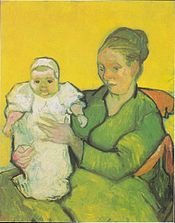
In Philadelphia Museum of Art'southward Portrait of Madame Augustine Roulin and Baby Marcelle Augustine holds baby Marcelle who was built-in in July, 1888. The mother, relaxed and her confront in a shadow, is passive. We tin can come across by the size of Augustine'south sloping shoulders, arm, and hands that she worked difficult to take care of her family unit. For instance, in that location were no modern conveniences similar washing machines. In a traditional pose of mothers and new babies, Augustine is holding her infant upright, supporting the baby'due south dorsum by her right arm and steadying the baby'due south midsection with her left hand. Marcelle, whose face is directed outward, is more active and engages the audience. Van Gogh used heavy outlines in blue around the images of mother and babe.[three]
To symbolize the closeness of mother and infant, he used side by side colors of the color bike, green, blue and xanthous in this piece of work. The vibrant yellow background creates a warm glow around mother and baby, like a very large halo. Of his employ of colour, Van Gogh wrote: "instead of trying to reproduce exactly what I have earlier my optics, I use color... to express myself more forcibly." The work contains varying brushstrokes, some straight, some turbulent - which allow us to see the move of free energy "similar water in a rushing stream." Émile Bernard, Van Gogh'southward friend, was the initial owner of this painting in its provenance.[three]

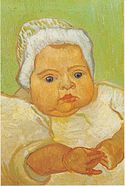

Portrait of Marcelle Roulin, 1888, Oil on Canvas, Fondation Socindec, Vaduz, Principality of liechtenstein (F441a)

Marcelle Roulin [edit]
Marcelle Roulin, the youngest child, was built-in on 31 July 1888, and 4 months quondam, when Van Gogh made her portraits.[20] She was painted iii times by herself and twice on her mother's lap.[17] The 3 works show the same caput and shoulders paradigm of Marcelle with her stubby cheeks and arms against a green background.[21] When Johanna van Gogh, significant at the fourth dimension, saw the painting, she wrote: "I like to imagine that ours will be just as stiff, just as beautiful – and that his uncle volition ane day paint his portrait!"[17] A version titled Roulin's Baby resides at the National Gallery of Art in Washington, D.C.[22]
In add-on to the mother-daughter works where Marcelle is visible, Van Gogh as well created several works where Augustine rocked her unseen cradle by a string.[4]
Camille Roulin [edit]
Camille Roulin, the eye child, was born in Lambesc in southern France, on x July 1877, and died on 4 June 1922. When his father had to answer to letters, he served as his secretary.[20] [23] When his portrait was painted, Camille was xi years of age. The Van Gogh Museum painting[eighteen] shows Camille'south head and shoulders. Yellowish castor strokes backside him are evocative of the sun.[24] The very similar painting resides at the Philadelphia Museum of Art (F537).[25]
In The Schoolboy with Uniform Cap Camille seems to exist staring off in space. His arm is over the back of a chair, rima oris gaped open, possibly lost in thought. This was the larger of the two works fabricated of Camille.[24]



Portrait of Armand Roulin, 1888, Museum Folkwang, Essen (F492)


Boyfriend with a Cap (Armand Roulin), 1888, Private Drove, Zürich, Switzerland (F536)
Armand Roulin [edit]
Armand Roulin, the eldest son, was built-in on five May 1871 in Lambesc, and died on fourteen November 1945. He was 17 years of age when portrayed by Van Gogh.[26]
Van Gogh'south works depict a serious young human being who at the time the paintings were made had left his parents' abode, working as a blacksmith'southward apprentice.[27] The Museum Folkwang piece of work depicts Armand in what are likely his all-time clothes: an elegant fedora, vivid xanthous coat, black waistcoat and tie.[24] [27] Armand's manner seems a bit sad, or mayhap bored by sitting.[24] His figure fills the picture aeroplane giving the impression that he is a confident, masculine young human being.[27]
The 2nd work, with his torso slightly turned aside and his eyes looking down, appears to be a pitiful young human being.[27] Even the bending of the lid seems to indicate sadness. Both museum paintings were made on large canvas, 65 ten 54 cm.[24]
La Mousmé [edit]
La Mousmé also known as La Mousmé, Sitting in a Cane Chair, Half-Effigy (with a branch of oleander) was painted Van Gogh in 1888 while living in Arles, which Van Gogh dubbed "the Japan of the south". Retreating from the city, he hoped that his time in Arles would evoke in his work the simple, notwithstanding dramatic expression of Japanese art.[2] [28] Inspired by Pierre Loti's novel Madame Chrysanthème and Japanese artwork, Vincent painted La Mousmé, a well-dressed Japanese girl. He wrote in a letter to his brother: "It took me a whole week...but I had to reserve my mental energy to do the mousmé well. A mousmé is a Japanese daughter—Provençal in this example—twelve to fourteen years old."[2] [28]
Van Gogh's use of color is intended to exist symbolic. The audience is fatigued in by his use of contracting patterns and colors that bring in an energy and intensity to the work. Complementary shades of blue and orangish, a stylistic deviation from colors of Impressionist paintings that he acquired during his exploration in Paris, stand out against the spring-like pale green in the groundwork. La Mousmé's outfit is a blend of modern and traditional. Her outfit is certainly mod. The vivid colors of skirt and jacket are of the southern region of Arles. Regarding Van Gogh's painting of her features, his greatest attention is focused on the girls face, giving her the coloring of a girl from Arles, just with a Japanese influence. The young lady'southward posture mimics that of the oleander. The flowering oleander, like the girl, is in the blossoming stage of life.[ii] [28]

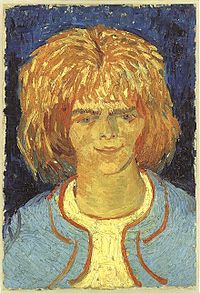
Daughter with Ruffled Hair (The Mudlark) [edit]
Another painting from this time Girl with Ruffled Pilus (The Mudlark) resides at Musée des Beaux-Arts, La Chaux-de-Fonds, Switzerland (F535).[29]
Saint-Rémy [edit]
In May 1889 Van Gogh voluntarily entered the Saint-Paul asylum[30] [31] nearly Saint-Rémy in Provence.[32] There Van Gogh had access to an adjacent jail cell he used as his studio. He was initially confined to the immediate asylum grounds and painted (without the confined) the earth he saw from his room, such as ivy covered trees, lilacs, and irises of the garden.[30] [33] Through the open bars Van Gogh could also see an enclosed wheat field, subject of many paintings at Saint-Rémy.[34] Equally he ventured outside of the aviary walls, he painted the wheat fields, olive groves, and cypress copse of the surrounding countryside,[33] which he saw as "characteristic of Provence." Over the course of the twelvemonth, he painted about 150 canvases.[30]
First Steps [edit]
First Steps is one of twenty-ane paintings that Van Gogh made in Saint-Rémy that were "translations" of the work of Jean-François Millet. He used black and white images of prints, reproductions or photographs to "pose equally bailiwick" and and then "improvised color on information technology." This source of the prototype for this piece of work, made Jan 1890, was a photograph of Millet'due south First Steps painting.[35]
Theo had sent the photograph of Millet's First Steps with perfect timing. Theo's married woman, Jo, was pregnant with their child, so it had special meaning to the family. In addition Van Gogh was still saddened by recent seizure episodes that impacted his mental clarity. Rather than vibrant colors, here he used softer shades of yellow, green and blueish. The picture depicts the begetter, having put down his tools, holding his arms outstretched for his kid'southward first steps. The mother protectively guides the child's movement.[36]
Evening: The Watch [edit]
Like the painting Get-go Steps, the painting Dark or Evening: The Picket depicts happy life of a rural family: father, mother and kid. Here the epitome seems bathed in yellow lite like that of the Holy Family.[37] A lamp casts long shadows of many colors on the flooring of the humble cottage. The painting includes soft shades of green and regal. The work was based on a print past Millet from his series, the four times of day.[38]
Van Gogh Museum says of Millet's influence on Van Gogh: "Millet'due south paintings, with their unprecedented depictions of peasants and their labors, mark a turning point in 19th-century art. Before Millet, peasant figures were just 1 of many elements in picturesque or nostalgic scenes. In Millet's work, individual men and women became heroic and existent. Millet was the only major artist of the Barbizon School who was not interested in 'pure' landscape painting."[39]
Theo wrote Van Gogh: "The copies subsequently Millet are perhaps the all-time things you have done yet, and induce me to believe that on the 24-hour interval you lot plough to painting compositions of figures, we may look forrard to cracking surprises."[40]
Auvers-sur-Ouise [edit]
After leaving the southward of France, Van Gogh's brother, Theo and artist Camille Pissarro developed a program for Van Gogh to get to Auvers-sur-Oise with a letter of introduction for Dr. Paul Gachet,[41] a homeopathic doc and art patron who lived in Auvers.[42] Van Gogh had a room at the inn Auberge Ravoux in Auvers[43] and was nether the care and supervision of Dr. Gachet with whom he grew to accept a close human relationship, "something like another brother."[43]
For a time, Van Gogh seemed to improve. He began to paint at such a steady pace, at that place was barely space in his room for all the finished paintings.[15] From May until his death on July 29, Van Gogh fabricated about 70 paintings, more than 1 a day, and many drawings.."[44] Van Gogh painted buildings around the boondocks of Auvers, such as The Church building at Auvers, portraits, and the nearby fields.[43]
Portraits of Trivial Children [edit]
Ii Immature Girls, also called Two Children is owned past Musée d'Orsay, Paris.[45] Another version of Two Children is office of a private collection (F784).[46]
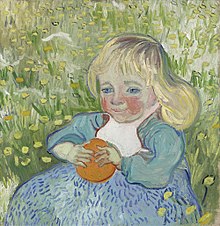
| | Two Children, 1890, Private Collection (F784) | Child with Orange, June–July, 1890, Private Drove (F785) |


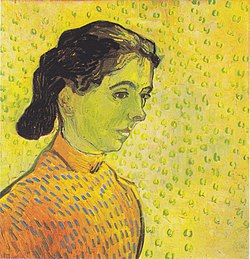
The Little Arlesienne [edit]
The Fiddling Arlesienne (Caput of a Girl) is plant at the Kröller-Müller Museum.[47]
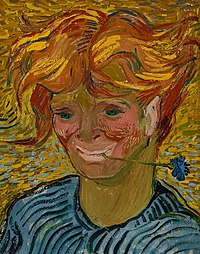
Young Human with Cornflower, June, 1890, Private collection, (F787)
Boyfriend with Cornflower [edit]
The Young Man with Cornflower was made in June, 1890 in Auvers.[48]
Adeline Ravoux [edit]
During his time in Auvers, Van Gogh rented a room at the inn of Arthur Ravoux, whose 16-year-onetime daughter sabbatum for three paintings. Van Gogh depicts Adeline, rather than a photographic resemblance, with "impassioned aspects" of gimmicky life through the "mod gustation for color."[49] Van Gogh wrote to his blood brother: "Last calendar week I did a portrait of a girl about 16, in blue confronting a blue background, the daughter of the people with whom I am staying. I take given her this portrait, simply I made a variation of it for you, a size 15 sheet."[50]
Adeline Ravoux was asked sixty-six years subsequently what she remembered of Van Gogh. Earlier he painted her portrait, van Gogh had only made polite exchanges of conversation with Adeline. 1 day, though, he asked her if she would be pleased if he were to do her portrait. After obtaining her parents permission, she saturday one afternoon in which he completed the painting. He smoked continually on his piping as he worked, and thanked her for sitting very nevertheless. She was very proud to sit down for the painting she described every bit a "symphony in blue". Van Gogh thought she was sixteen, but she was only 13 years of age at the time. Adeline sat just once, but three paintings were made of her:[l]
- For the sitting, Adeline was dressed in a blue dress, the background was blueish and her pilus ribbon was blue.
- Van Gogh made a copy of the original painting for his brother, with slightly dissimilar shades of blue.
- In a slightly different pose or aspect, Adeline appears against a groundwork of roses, portions of a withal life of roses (F595) that he completed but a few days prior to this painting. This painting is owned by the Cleveland Museum of Art.[fifty]
Neither she nor her parents appreciated Van Gogh's way and were disappointed that information technology was non true to life.[50] Yet, even though Adeline was a young daughter at the time, pictures of her as a young adult female showed that van Gogh painted her as she would become.[1]
| Portrait of Adeline Ravoux (Half-Figure), 1890, Private Collection (F768) | Portrait of Adeline Ravoux, June, 1890, Private Drove (F769) | |


References [edit]
- ^ a b c Cleveland Museum of Art (2007). Monet to Dalí: Impressionist and Modernistic Masterworks from the Cleveland Museum of Art. Cleveland: Cleveland Museum of Art. p. 67. ISBN978-0-940717-89-3.
- ^ a b c d "La Mousmé". Postimpressionism. National Gallery of Art. 2011. Archived from the original on May 10, 2011. Retrieved March 20, 2011Additional information about the painting is establish in the sound prune.
{{cite web}}: CS1 maint: postscript (link) - ^ a b c d "Portrait of Madame Augustine Roulin and Baby Marcelle". Collections. Philadelphia Museum of Art. 2011. Retrieved Apr 13, 2011Additional data in "Instructor Resources" and audio clip.
{{cite web}}: CS1 maint: postscript (link) - ^ a b c Lubin, A (1996) [1972]. Stranger on the Earth: A Psychological Biography of Vincent van Gogh. Da Capo Press. p. 15. ISBN0-306-80726-ii.
- ^ van Gogh, V, van Heugten, S, Pissarro, J, Stolwijk, C (2008). Van Gogh and the Colors of the Night. Brusells: Mercatorfonds with Van Gogh Museum and Museum of Modernistic Art. pp. 12, 25. ISBN978-0-87070-736-0.
{{cite book}}: CS1 maint: multiple names: authors list (link) - ^ Wallace, R (1969). The Earth of Van Gogh (1853-1890) . Alexandria, VA, Us: Time-Life Books. pp. ten, 14, 21, xxx.
- ^ van Gogh, G, Bassil, A (2004). Vincent Van Gogh. Milwaukee, WI: World Almanac Library. p. 24. ISBN0-8368-5602-3.
{{cite volume}}: CS1 maint: multiple names: authors list (link) - ^ Gayford, M (2008) [2006]. The Yellow House: Van Gogh, Gauguin, and 9 Turbulent Weeks in Provence. Mariner Books. pp. 195–196. ISBN978-0-618-99058-0.
- ^ "Male child Cutting Grass with a Sickle". Van Gogh Gallery. 2011. Retrieved April 13, 2011.
- ^ "Girl in a wood". Collection. Kröller-Müller Museum. Retrieved April thirteen, 2011.
- ^ van Gogh, V (2011). Harrison, R (ed.). "Letter from Vincent van Gogh to Theo van Gogh, The Hague, xx August 1882". Letters of Vincent van Gogh. van Gogh, J (trans.). WebExhibits. Retrieved April 12, 2011.
- ^ Lubin, A (1996) [1972]. Stranger on the Earth: A Psychological Biography of Vincent van Gogh. Da Capo Press. pp. 5–6. ISBN0-306-80726-two.
- ^ "Van Gogh Paintings". Van Gogh Gallery. 2011. Retrieved April 13, 2011.
- ^ Lubin, A (1996) [1972]. Stranger on the Earth: A Psychological Biography of Vincent van Gogh. Usa: Da Capo Press. pp. 74–75. ISBN0-306-80726-2.
- ^ a b c Wallace, R (1969). The World of Van Gogh (1853-1890) . Alexandria, VA, U.s.a.: Time-Life Books. pp. 40, 69.
- ^ a b Morton, M; Schmunk, P (2000). The Arts Entwined: Music and Painting in the Nineteenth Century. New York: Garland Publishing. pp. 177–178. ISBN0-8153-3156-8.
- ^ a b c "Portrait of Marcelle Roulin, 1888". Permanent Drove. Van Gogh Museum. 2005–2011. Archived from the original on May 16, 2013. Retrieved April thirteen, 2011.
- ^ a b "Portrait of Camille Roulin, 1888". Permanent Collection. Van Gogh Museum. 2005–2011. Retrieved Apr 13, 2011.
- ^ Gayford, Yard (2008) [2006]. The Yellow House: Van Gogh, Gauguin, and Nine Turbulent Weeks in Provence. Mariner Books. p. 212. ISBN978-0-618-99058-0.
- ^ a b Letter xxx
- ^ Gayford, One thousand (2008) [2006]. The Xanthous House: Van Gogh, Gauguin, and Nine Turbulent Weeks in Provence. Mariner Books. p. 216. ISBN978-0-618-99058-0.
- ^ "Roulin's Babe". The Collection. National Gallery of Art. 2011. Archived from the original on May 8, 2009. Retrieved April 13, 2011.
- ^ Letter of Joseph Roulin to Vincent van Gogh, 24 October 1889; see Van Crimpen & Berends-Alberts (1990), pp. 1957-58 (Nr. 816) - run across previous note.
- ^ a b c d e Gayford, Chiliad (2008) [2006]. The Yellow House: Van Gogh, Gauguin, and Ix Turbulent Weeks in Provence. Mariner Books. pp. 213–214. ISBN978-0-618-99058-0.
- ^ "Portrait of Camille Roulin". Collections. Philadelphia Museum of Art. 2011. Retrieved Apr thirteen, 2011.
- ^ Messages of Joseph Roulin to Vincent van Gogh, 22 May and 24 October 1889; see Van Crimpen, Han & Berends-Alberts, Monique: De brieven van Vincent van Gogh, SDU Uitgeverij, The Hague 1990, pp. 1878-79 (No. 779); 1957-58 (Nr. 816) - both letters, written in French, are hitherto only published in Dutch translation.
- ^ a b c d Zemel, C. Van Gogh'south Progress: Utopia, Modernity, and Belatedly-Nineteenth-Century Art. pp. 108–110.
- ^ a b c Jessup, ed. (2001). "Van Gogh in the South". Antimodernism and Artistic Experience. Toronto: University of Toronto Press. p. 185. ISBN0-8020-8354-four.
- ^ "Daughter with Ruffled Pilus (The Mudlark)". Van Gogh Gallery. 2011. Retrieved April 13, 2011.
- ^ a b c "Heilbrunn Timeline of Art History". Thematic Essay, Vincent van Gogh. The Metropolitan Museum of Art. 2000–2011. Retrieved March 25, 2011.
- ^ "Olive Trees, 1889, Van Gogh". Collection. Minneapolis Plant of Arts. Archived from the original on September 8, 2012. Retrieved March 25, 2011.
- ^ "Olive Trees, 1889, van Gogh". Collection. The Metropolitan Museum of Fine art. 2000–2011. Retrieved March 25, 2011.
- ^ a b "The Therapy of Painting". Van Gogh Museum. Retrieved March 25, 2011.
- ^ Van Gogh, V & Leeuw, R (1997) [1996]. van Crimpen, H & Berends-Albert, M. (eds.). The Letters of Vincent van Gogh. London and other locations: Penguin Books. p. F604.
- ^ "Vincent van Gogh: First Steps, after Millet". Heilbrunn Timeline of Fine art History. The Metropolitan Museum of Fine art. December 2008. Retrieved Apr 13, 2011.
- ^ Maurer, Northward (1999) [1998]. The Pursuit of Spiritual Wisdom: The Idea and Art of Vincent van Gogh and Paul Gauguin. Cranbury: Associated University Press. p. 99. ISBN0-8386-3749-iii.
- ^ Zemel, C. Van Gogh'southward Progress: Utopia, Modernity, and Late-Nineteenth-Century Art. p. 17.
- ^ "Nighttime (subsequently Millet), 1889". Permanent Collection. Van Gogh Museum. 2005–2011. Retrieved April 14, 2011.
- ^ "Jean-François Millet". Permanent Collection. Van Gogh Museum. 2005–2011. Retrieved Apr 14, 2011.
- ^ Harrison, R (ed.). "Theo van Gogh. Letter to Vincent van Gogh. Written iii May 1890 in Saint-Rémy". van Gogh, J (trans.). WebExhibits. Retrieved April 12, 2011.
- ^ Wallace, R (1969). The World of Van Gogh (1853-1890) . Alexandria, VA, Us: Time-Life Books. pp. 162–163.
- ^ Strieter, T (1999). Nineteenth-Century European Art: A Topical Dictionary . Westport: Greenwood Press. p. 17. ISBN0-313-29898-X.
- ^ a b c Leeuw, R (1997) [1996]. The Messages of Vincent van Gogh. London and other locations: Penguin Group. pp. 488, 490, 491.
- ^ "Girl in White, 1890". The Collection. National Gallery of Art. 2011. Archived from the original on August 30, 2016. Retrieved March 21, 2011.
- ^ "2 Fillettes (Two Young Girls)". Index of Works. Musée d'Orsay. 2006. Retrieved April xiii, 2011.
- ^ "Two Children". Van Gogh Gallery. 2011. Retrieved Apr 13, 2011.
- ^ "Portrait of a Young Woman". Collection. Kröller-Müller Museum. Archived from the original on July 22, 2011. Retrieved April xiii, 2011.
- ^ "Boyfriend with Cornflower". Van Gogh Paintings. Van Gogh Gallery. Retrieved April 12, 2011.
- ^ "Adeline Ravoux". Collections Online. Cleveland Museum of Fine art. Retrieved April 13, 2011.
- ^ a b c d Leaf, A; Lebain, F (2001). Van Gogh's Tabular array: At the Auberge Ravoux. New York: Artisan. pp. 51–52. ISBN978-i-57965-315-6.
External links [edit]
Source: https://en.wikipedia.org/wiki/Paintings_of_Children_(Van_Gogh_series)
0 Response to "Vincent Van Gogh as a Child Vincent Van Gogh as a Baby"
Post a Comment